
1. Introduction
Anthropic proposed the J-lens as a powerful tool for verbalizing the internal thoughts of a large language model. The recipe is as follows: compute the Jacobian $J^{(\ell)} \in \mathbb{R}^{d_m \times d_m}$ of the output-layer residual stream $\mathbf{h}^{(L)}$ with respect to an internal layer $\mathbf{h}^{(\ell)}$, averaged over a corpus of prompts and token positions, then multiply by the unembedding matrix $W_U \in \mathbb{R}^{d_V \times d_m}$ to obtain a set of residual stream vectors $\mathbf{v}^{(\ell)}_a$, the rows of $W_U J^{(\ell)}$ associated to each vocabulary token $a.$ The J-lens may be “read” at layer $\ell$ by passing a prompt through the model up to layer $\ell$, obtaining a residual-stream activation $\mathbf{h}^{(\ell)} \in \mathbb{R}^{d_m}$, and interpreting $\mathbf{v}^{(\ell)}_a \cdot \mathbf{h}^{(\ell)}$ as logits over the $d_V$ tokens in the vocabulary, indexed by $a.$ The “top J-lens vectors” as ordered by these logits have been shown in numerous examples to reflect something about the model’s intermediate reasoning steps.
Since the original J-lens proposal, several modifications have been put forward with the goal of “cleaning up” the J-lens, which in its original form often contains noise in the form of unrelated tokens that are not obviously germane to the prompt at hand. These include the R-lens and the J++ lens. Both involve a tailored modification to the J-lens: in the R-lens, layer-wise relevance propagation (LRP) rules are used in the backward pass to reduce the accumulation of gradient noise across layers, and in J++, LRP is used along with learned weights for partitions of the Jacobian into “expert” clusters in activation space. The J++ lens in particular has been shown to improve fidelity in extracting intermediate concepts, though in part this is because the J++ readout is explicitly restricted to word-like tokens (containing at least one letter or digit).
In this work, we show that in experiments on three open models (Llama-3.3-70B-Instruct, Qwen3.5-4B, OLMo-3 32B base), centering the J-lens increases verbalizability without explicit vocabulary filtering, and helps in surfacing intermediate non-verbalized concepts in the chain-of-thought on multi-step reasoning problems.
2. Centering the J-lens
Our construction is:
- Average over a corpus to obtain the mean residual vector $\bar{\mathbf{h}}^{(\ell)}$ at every layer of the model. The corpus could be a generic corpus like Wikitext, or for more targeted reads, the specific corpus from which the desired prompts are drawn (e.g. the GSM8K questions intended to probe mathematical reasoning.) The centered residual1 for a given prompt is obtained by subtracting the mean from the raw residual, $$\Delta \mathbf{h}^{(\ell)} \equiv \mathbf{h}^{(\ell)} - \bar{\mathbf{h}}^{(\ell)}$$
- Subtract the mean of the rows of the unembedding matrix, $\bar{\mathbf{w}} \in \mathbb{R}^{d_m}$, to obtain the centered unembedding matrix $$(\Delta W_U)_{ai} \equiv (W_U)_{ai} - \bar{w}_i$$ where $a$ runs over the $d_V$ vocabulary tokens and $i$ indexes the residual stream components. The centered J-lens is the product of the Jacobian with the centered unembedding, and the centered J-lens vectors2 $\Delta \mathbf{v}_a^{(\ell)}$ at layer $\ell$ are the rows of this matrix, $$(\Delta v^{(\ell)}_a)_i \equiv (\Delta W_U J^{(\ell)})_{ai}$$
- Compute the cosines of the angles between the centered residual and the centered J-lens vectors, $$o_a^{(\ell)}(\Delta \mathbf{h}^{(\ell)}) \equiv \cos \theta_{\Delta v_a, \Delta h} = \frac{\Delta \mathbf{v}_a^{(\ell)} \cdot \Delta \mathbf{h}^{(\ell)}}{||\Delta \mathbf{v}_a^{(\ell)}|| \, ||\Delta \mathbf{h}^{(\ell)}||}$$ In particular, this involves dividing the dot product by the norm of each centered J-lens vector $\Delta \mathbf{v}_a^{(\ell)}$, which varies from token to token. We refer to $o_a^{(\ell)}$ as the overlaps of each residual at layer $\ell$: ranking the overlaps furnishes the top vocabulary tokens for each residual.
The motivation for centering the residual is that by averaging over prompts, the Jacobian is effectively a Taylor expansion about the model’s mean activation at a given layer: $$f(\mathbf{h}^{(\ell)}) = f(\bar{\mathbf{h}}^{(\ell)}) + J^{(\ell)}\cdot(\mathbf{h}^{(\ell)}-\bar{\mathbf{h}}^{(\ell)}) + \dots$$The motivation for centering the unembedding matrix is that the mean unembedding vector $\bar{\mathbf{w}}$ is semantically meaningless, so this common component of all J-lens vectors should be subtracted.3 The main utility of the centered J-lens vectors is a complementary definition of J-space occupancy, as we describe in Section 4 below. Most of the individual steps of our construction have been previously applied to the J-lens (see references in footnotes), but to our knowledge the combination of steps 1-3 has not been studied prior to our work.
A slice viewer in the style of Anthropic's original post can be found here.
3. Quantitative metrics
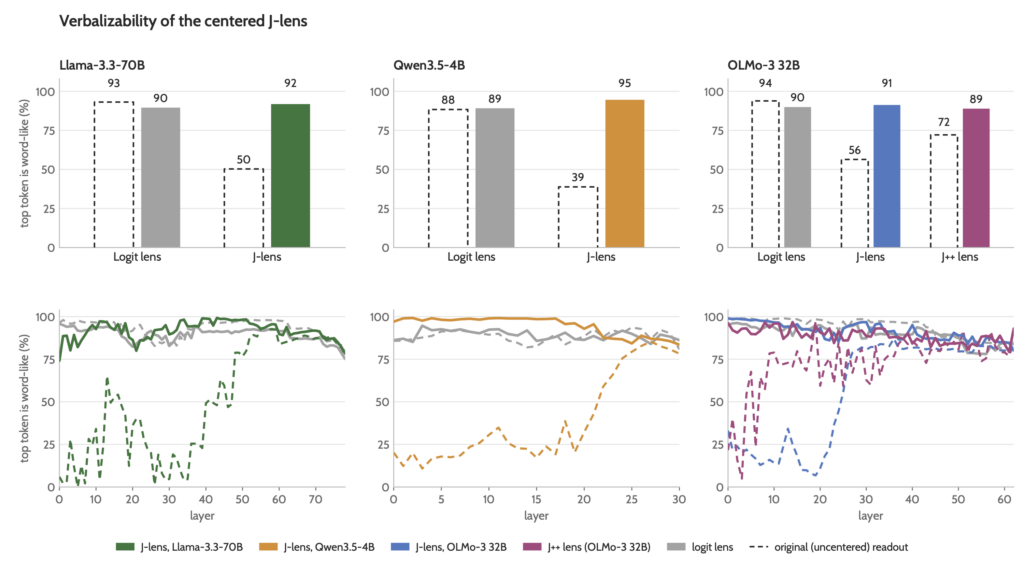
Fig. 1 shows the verbalizability of the J-lens in the three models we study. We also compare the logit lens, as well as the publicly-released J++ lens on OLMo without the readout filtering step. The top panel shows the percentage of cells (layers $\times$ positions) in which the models, reading 145 two-hop questions from the MuSiQue multi-hop benchmarks, have a top J-lens or logit lens token which is word-like (containing a letter or digit, and not a special token). The bottom panel shows the percentage of token positions with verbalizable readout, layer by layer. The mean activation $\bar{\mathbf{h}}$ for the centering was taken over 384 positions drawn from 8 held-out Wikitext passages. Centering markedly improves the verbalizability of the J-lens and J++ lens, especially in early layers, while not significantly affecting the logit lens. Apparently, the true overlap of the J-lens vectors with the residual stream is dominantly onto word-like tokens once the mean activation is subtracted, which means that an ad-hoc restriction to verbalizable concepts is not necessary.
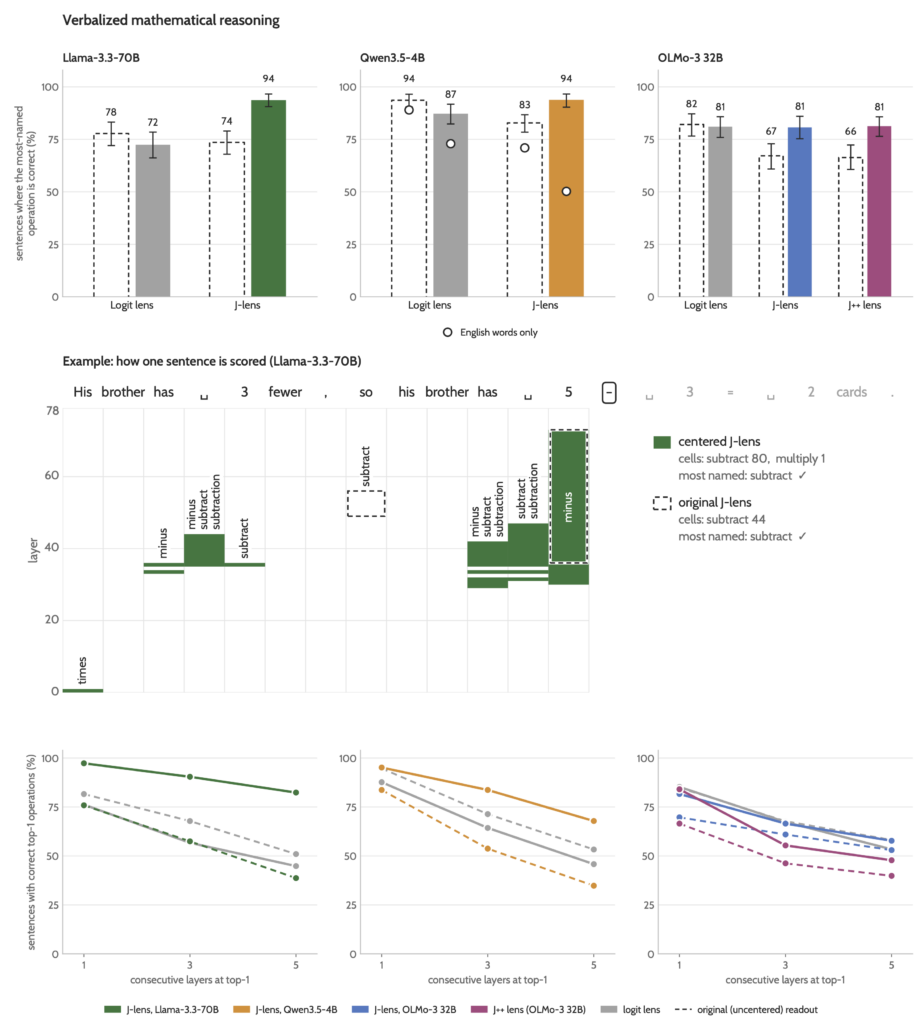
Fig. 2 demonstrates how centering the J-lens can elucidate verbalized mathematical reasoning. Each model answers questions from the GSM8K benchmark set, and on the first 100 the model answers correctly, we look for sentences in the chain of thought (CoT) where the top token by its own ranking (logits for the original lenses, overlaps for the centered ones) names the correct mathematical operation at CoT positions before the appropriate symbol ($+$, $-$, $\times$, $\div$) is written.4 The mean activation $\bar{\mathbf{h}}$ for the centering was taken over 64 GSM8K training questions, to avoid confounding the appearance of mathematical words with the fact that the prompt itself is about math. The top panel shows the percentage of sentences where the correct mathematical operation is named most often in the lens readout; we count the position/layer pairs where the top-1 lens token is a word for one of the four math operations, and pick the operation with the largest count. The middle panel shows an example of a sentence from one of the examples in the slice viewer, which is scored as containing the correct operation. The concept "subtract" appears at several positions well before the symbol "$-$" appears.5 The metric in Fig. 2 penalizes false positives which either name random mathematical operations in every sentence (which would give 25%), or name only the most common operation in the GSM8K questions, multiplication (~40%). Neither appears to be the case: on all models, the correct operation is named in the centered J-lens at rates well above chance, approaching 100% in both Llama and Qwen. Even this value is likely an undercount, as non-operation-specific tokens like "subtotal" appear quite often in logical positions near the end of the CoT, as can be seen in the slice viewer.
The bottom panel of Fig. 2 shows the percentage of sentences where the correct operation is top-1 in a single layer, 3 consecutive layers, or 5 consecutive layers. Here, centering mildly hurts the logit lens but dramatically improves performance of the J-lens (and J++) on all models. As demonstrated in the example in the middle panel, several blocks of consecutive layers have the correct operation named. Most strikingly, Qwen's English verbalizability decreases under centering, but its Chinese verbalizability shows the same marked increase as Llama, suggesting that the model performs its internal mathematical reasoning in Chinese.
4. Occupancy via overlap
Our notion of overlap via centering also leads to a complementary definition of the occupancy of the J-space. Define a baseline overlap by rotating the centered residual by random orthogonal matrices, computing the overlaps as in steps 2-3 in Sec. 2, and identifying the maximum overlap among all J-lens vectors with the rotated residual: $$\widetilde{\mathbf{h}}^{(\ell)} \equiv O \Delta \mathbf{h}^{(\ell)}, \ O \in {\rm O}(d_m); \qquad c^{(\ell)} = \mathbb{E}_O [\max_a o_a^{(\ell)}(\widetilde{\mathbf{h}}^{(\ell)})].$$ The excess overlap count $E$ is the number of centered J-lens vectors $\Delta \mathbf{v}_a^{(\ell)}, a = 1, 2, \dots, E$ having $o_a^{(\ell)} > c^{(\ell)}$. Many of these vectors correspond to similar tokens (e.g. _Fred, Fred, and fred), and unsurprisingly, their J-lens vectors are nearly parallel. We thus define the overlap occupancy $K$ as the participation ratio of the Gram matrix of the excess overlap vectors, which measures the effective number of orthogonal directions among the $E$ vectors: $$K = \frac{(\sum_{i=1}^E \lambda_i)^2}{\sum_{i=1}^E \lambda_i^2}, \qquad \lambda_i: {\rm eigenvalues \ of} \ M_{ab} = \frac{1}{E}\Delta \mathbf{v}_a^{(\ell)} \cdot \Delta \mathbf{v}_b^{(\ell)}.$$ By construction, $K$ ranges between 1 (when there is a single linearly-independent vector) and $E$ (when all the vectors are mutually orthogonal), and in practice we find that $K$ is typically of order 20 in the middle layers of the model, as shown in Fig. 3. This overlap occupancy of the J-space is consistent at the order-of-magnitude level with the occupancy definition via gradient pursuit in Anthropic’s original work, which is used to support the conclusion that the J-space is a sparse subframe of the overcomplete span of all J-lens vectors.
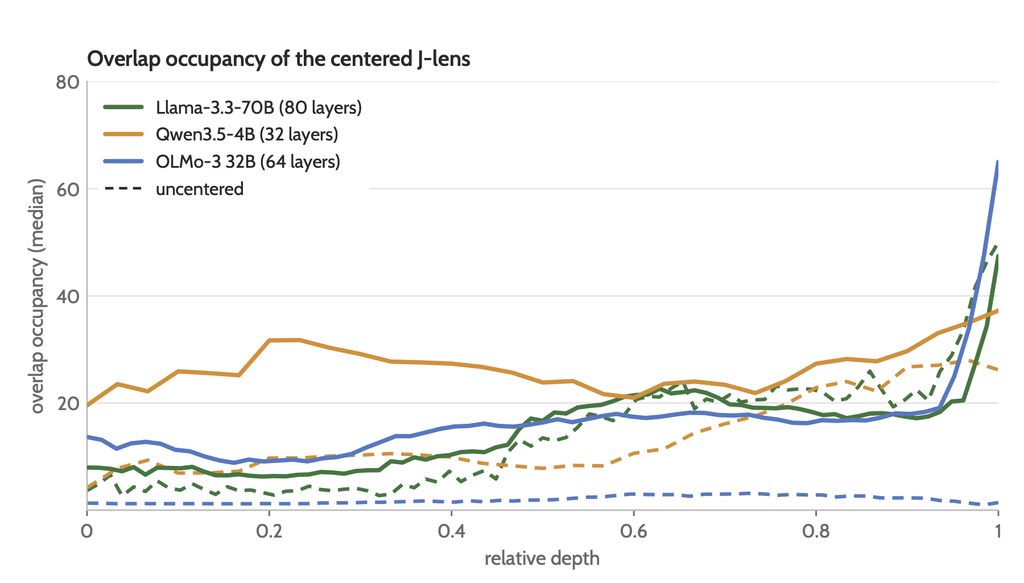
In the slice viewer we only list the top $E$ vectors of the J-lens, since $E$ provides a natural upper bound on which J-lens vectors are significant.6 We also show in Fig. 3 the overlap occupancy using the uncentered vectors $\mathbf{v}_a^{(\ell)}$ and $\mathbf{h}^{(\ell)}$. The effect of this change varies widely across models, but the uncentered occupancy is typically smaller than the centered occupancy. Centering helps magnify their components orthogonal to the mean, resulting in the increased verbalizability we saw in Section 3.
Interestingly, overlap occupancy is significantly reduced at certain positions in middle layers, which we tentatively interpret as the model appearing confident about an intermediate concept. In a multi-hop question which the model must use chain-of-thought to answer ("Two-hop question 2 (with CoT)" in the slice viewer), the correct final answer Fred given by Llama-3.3-70B-Instruct appears in the centered J-space with $E=3$ and $K=1.6$ at layer 72, position 138: inspecting the readout shows that the dominant direction is shared by three nearly-identical tokens _Fred, Fred, and fred sharing an effective direction. By contrast, Qwen3.5-4B, which does not correctly answer, prepares to hallucinate a response at the token before it answers (layer 22, position 145): $E = 360$ and $K = 36.2$, spanned by generic English male names (_Jimmy, _Eddie, _Tommy, _Pete, etc.).
5. Conclusions
We confirm Anthropic's finding that the J-lens is a powerful tool for interpretability, and we demonstrate that a simple modification to the original prescription yields a centered J-lens which surfaces word-like tokens across more layers and significantly improves the verbalization of mathematical concepts in the chain of thought. This centering can also be applied to the J++ lens, and on the one model (OLMo-3 32B) with a released J++ lens that we tested, the benefits seem to compound: centered J++ is strictly better on the GSM8K example, and may obviate the need for explicit readout filtering.
- To our knowledge, centering the residual was first applied to the J-lens in https://ameya-bit.github.io/posts/jlens-offset/, which increased verbalization of non-Latin tokens in Qwen; this is consistent with our observations in Section 3. See also https://arxiv.org/abs/2611.26590 for centering applied to vision-language models, where $\bar{\mathbf{h}}$ is taken over a corpus of images rather than a corpus of text. ↩︎
- Centering the unembedding matrix was (to our knowledge) first applied to the J-lens in a replication experiment on GPT-2. ↩︎
- In our experiments we have found that ranking tokens via overlaps with the uncentered J-lens vectors (i.e. dropping step 2) is mildly detrimental to our quantitative metrics, due to the changing norm of the uncentered J-lens vector in the denominator. ↩︎
- In 95-97% of graded sentences (depending on the model), a word for the operation is never verbalized anywhere in the CoT; when it does, it is almost always "times" or "difference" while the J-lens surfaces synonyms like "multiplication" and "subtract". ↩︎
- Note that the slice viewer uses the Wikitext mean $\bar{\mathbf{h}}$, rather than the GSM8K mean, and only shows even layers, so the example in Fig. 2 does not correspond layer-for-layer to the slice viewer. Nonetheless, many of the same qualitative features are present in both the figure and the viewer, which demonstrates the robustness of the centering procedure to the precise choice of mean. ↩︎
- In cases where $E$ is very large, we truncate the list, though in these cases $K$ still remains small. ↩︎
Acknowledgments
This research is based on work supported by the Canadian AI Safety Institute Research Program at CIFAR and a donation of Claude Code subscriptions from Anthropic. Resources used in preparing this research were provided, in part, by the Province of Ontario, the Government of Canada through CIFAR, and companies sponsoring the Vector Institute.
This publication was in part supported by Principles of Intelligence through the Fields Institute - Principles of Intelligence Postdoctoral Fellowship program.
The authors are grateful to Cursor for computational resources that made possible numerous experiments within this work.
The authors are grateful to Arul Shankar and Jacob Tsimerman for their encouragement, and to Joshua Batson for many discussions about the J-lens.